Reasonable Rarity - Proofs are Philately's Beautiful Miniature Works of Art!
Types of Proofs
The Scott Specialized Catalogue of U.S. Stamps lists hundreds of varieties of proofs and trial color proofs from the Postmasters' Provisionals of New York (1845) and Providence (1846) to the 6¢ 50th Anniversary of Powered Flight airmail of May 1953. Although proofs are known to exist in many varied styles, those listed below are the most common:
Large Die Proofs
Large die proofs were usually printed on India paper about the size of the engraver's die block, 2" × 2½", or larger. The India paper is then covered for protection with a thin soft white cardboard, called "blotter", about 6" × 8" in size, and passed under the heavy roller of the hand press. When it is pulled off the Proofer's hand press, the inked design adheres to the India paper and the India paper adheres to the card which has the sinkage of the full steel die block pressed into it. The product is a large die proof. For the classic stamp period of 1847 to about 1902, large die proofs available to philatelists come from ex-officials and the holdings of the engravers of the designs.
Plate Proofs
Plate proofs are found on both India paper and card stock. They were made from finished plates and are excellent impressions, showing sharpness and color far superior to the stamps themselves. India paper is a thin, soft, opaque paper which wrinkles when wet. Card is a plain, clear white card of good quality, which is found in different thicknesses for different printings. Copies of plate proofs on card were printed in five batches of 500 for each issue then existing between 1879 and 1893.
Hybrid Proofs
Hybrid proofs are actually plate proofs and exist for all issues prior to 1894. They have been cut to shape and pressed onto large cards to resemble the large die proofs.
Small Die Proofs
Small die proofs, commonly referred to as Roosevelt Album Proofs, consisted of 308 designs representing most issues from 1847 through 1902. A total of eighty-five leather-bound gold gilt embossed album sets were printed by the Bureau of Engraving and Printing in 1903 and distributed to friends and political cronies of the Post Office Department. The proofs were printed on a fibrous, white wove paper, mounted on gray cardstock and are quite rare. In addition, another special printing of 413 different small die proofs was made for the 1915 Panama-Pacific Exposition. These were produced on a soft, yellowish wove paper, and are extremely scarce, with 3–5 copies of each known today.
Up until the early 1900's, stamp proofs were available to the stamp trade. In early days, congressmen could secure them for their constituents upon request. Thousands were distributed in this manner, creating a collecting irony of sorts: The proofs of modern U.S. stamps usually are not available, while older proofs are frequently offered for sale. Today, proofs are retained only by the Bureau of Engraving and Printing and the United States Postal Service. Engravers were allowed to keep a proof for themselves long after they became unavailable for congressional requests, but those were the only copies outside of government ownership. Occasionally, a retired engraver's estate may include a proof for outside sale, but that is extremely infrequent.
Proofs are an attractive collecting example of the "art" of the stamp design as well as representing the production process and, in some cases, the political intrigue of the United States Post Office Department. This Collection focuses primarily on the three following proofs—Plate Proofs on Card, Roosevelt Album Small Die Proofs, and Atlanta Trial Color Proofs.
Plate Proofs on Card
Plate proofs on card are a great entry point into collecting proofs. They are less expensive and have much larger quantities available to collectors than Roosevelt or Atlanta proofs. The album below presents my complete collection of plate proofs on card for the classic stamp period. Enjoy.
Roosevelt Small Die Proofs - 1847-1902
Roosevelt Small Die Proofs represent unique political intrigue and are quite rare at 85 issued each. In my humble opinion, these proofs were hidden for 100 years, are cheap for their rarity at $187 average catalog value each, and are now unveiled by the Internet!
These proofs offer collectors a chance to own reasonably rare material with historical significance at a fraction of what similar rarity would cost in other collecting areas.
Atlanta Trial Color Proofs - 1847-1881
Atlanta Trial Color Proofs are also quite rare at 100 issued each. They represent beautiful art in five different colors! Even now, there is uncertainty about how they arrived, but research continues to uncover their fascinating history.
These proofs are about half the cost of the Roosevelt proofs, making them an excellent entry point into collecting favor printings and reasonable rarity.
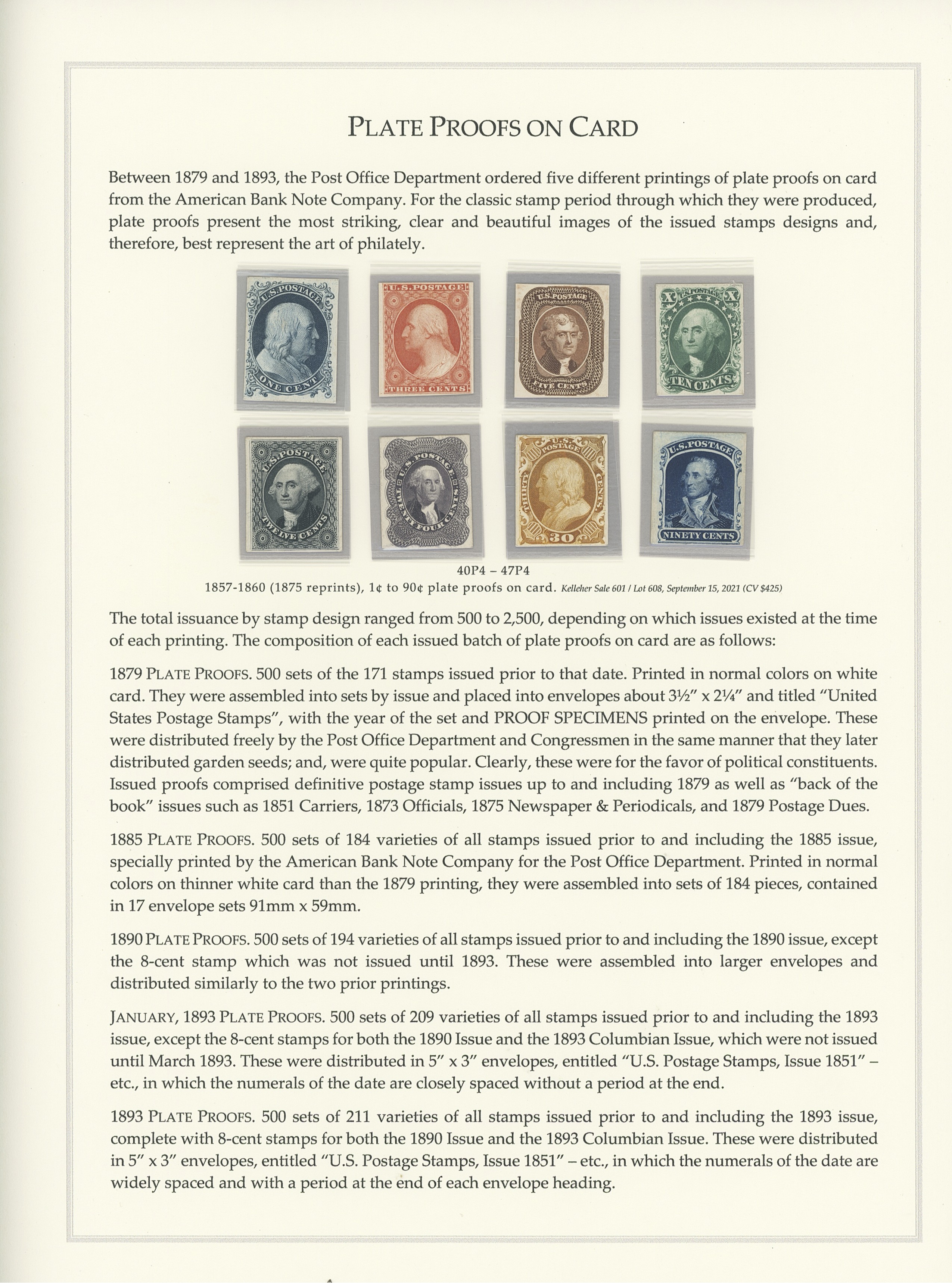
Plate and Die Proofs
View PDF →
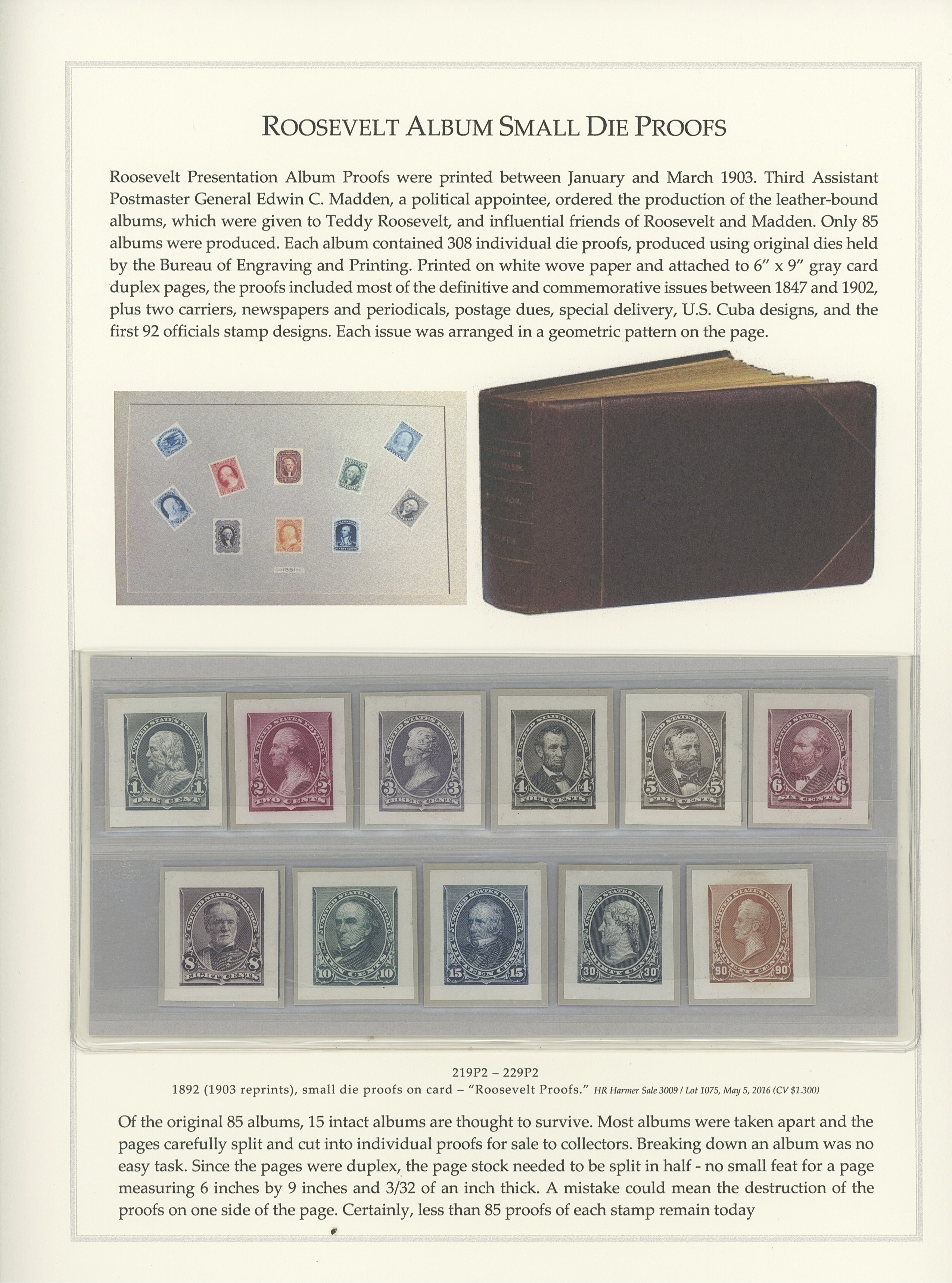
Roosevelt Presentation Album Proofs
Click to view in US Classic Stamp Viewer →
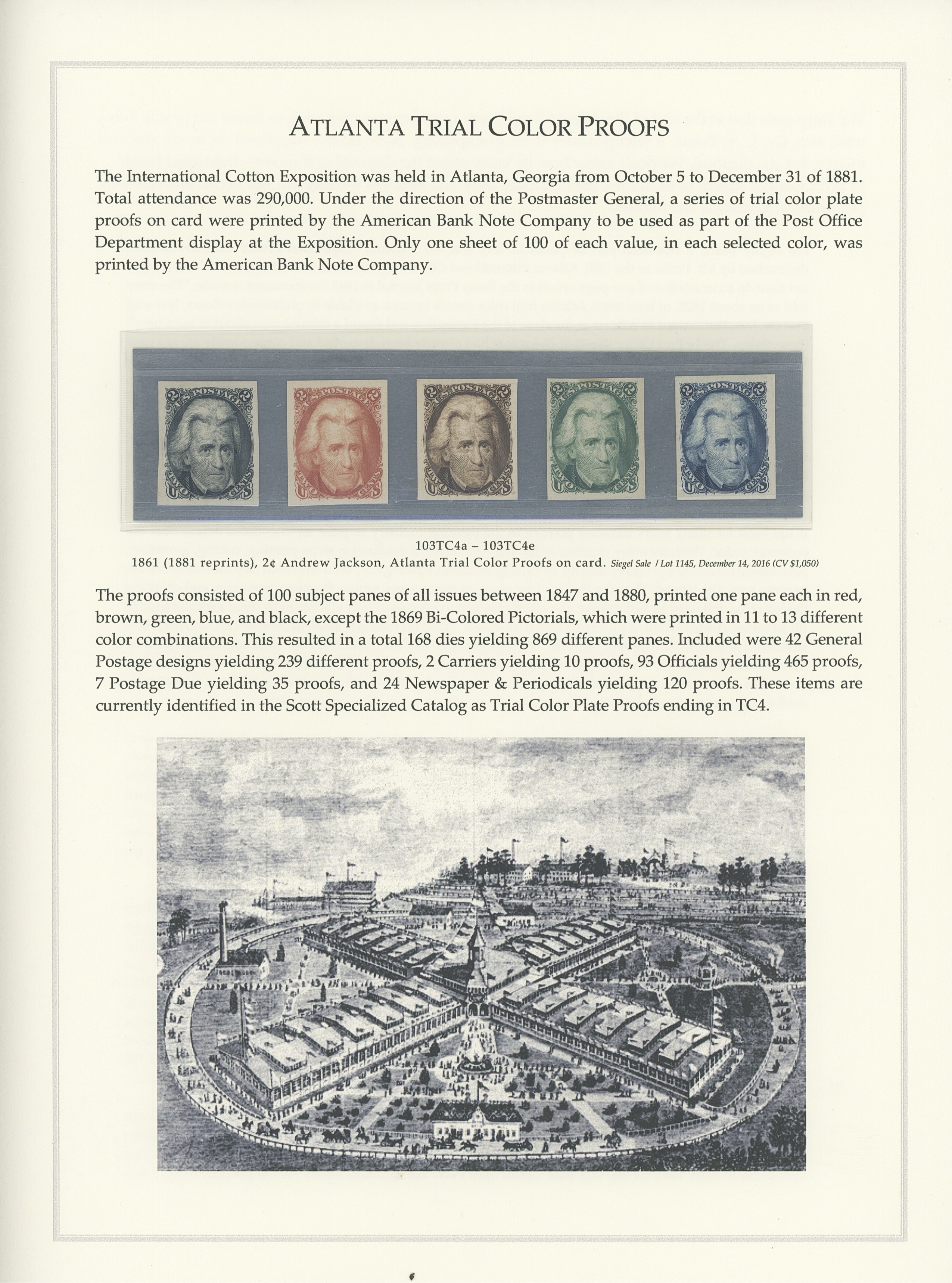
Atlanta Trial Color Proofs
Click to view in US Classic Stamp Viewer →
Plate and die proofs (first) are more affordable and more available; Roosevelt and Atlanta are the last two volumes of my Advanced US collection.
Understanding Philatelic Rarity
This section explores philatelic rarity and considers how philatelic rarity does not always square up with philatelic demand, scarcity, and values of rare items. After exploring this topic, the notion of collecting reasonable rarity is suggested.
Rare
Rare means there aren't very many of them. Rarity is generally not changed by perception, behavior or economics—it is a determined quantity. In philately, there is no defined number that classifies a stamp as "rare," but it seems quite reasonable to say that any philatelic item with less than 200 copies in existence should be considered rare.
Ignoring covers and usages, rare United States postal items appear in a number of categories:
- 19th Century, with few surviving
- 19th Century, in mint never hinged condition
- 19th Century, in large blocks
- First two issues - in important plate positions
- Used - several early high denomination stamps
- Used - several early 20th century booklet panes, coil pairs
- Used - certain early special printings
- Error - double printing, inverted centers, colors
- Special printing - political favors, exhibitions, payment for services
Scarce
Scarce means there aren't enough of them to meet the demand for them. Scarcity is affected by perception, behavior and economics. The determining factor for a rare item to also be scarce is demand.
Demand
Demand is a buyer's willingness and ability to pay for them. Demand is affected by many factors including the item's rarity, price of related items, condition, buyer's disposable income, tastes, expectations about future prices and availability, and expectations about the future population of those who would desire this item.
Value
Value is the worth or importance of an item in comparison with something else. Key factors that currently drive philatelic value are buyer preferences, the used versus unused state of an item, the condition of an item, the item's historical price, the item's rarity and its perceived scarcity.
Special "favor" printings are among the more interesting historical items because they were officially issued by government authorities, generally politically driven, and they occurred during a relatively short window of time—1870-1915. The first political favor printings (the 85 Roosevelt Proof Albums) and special printings (100 The Atlanta Trial Color Proofs and the 3-5 Panama Pacific Exhibition Proofs) were not cured by additional printings, so they all remain rare.
Reasonable Rarity
With rarity, scarcity, demand, and value examined, there are a number of rare philatelic items that are not expensive. The two most obvious items to me are the 1881 Atlanta Trial Color Proofs, with 100 quantities issued, and the 1903 Roosevelt Presentation Album Proofs, with 85 quantities issued.
Interestingly, Roosevelt Presentation Album Proofs of 1903 and Atlanta Trial Color Proofs of 1881 are generally not identified in philatelic rarity censuses. However, they are rare, and certainly rarer than a number of items included in recognized rarity censuses. There are very few stamps with this rarity and they are all quite expensive. It is also not that proofs are excluded from rarity censuses, because a number of proofs are included.
While Proofs are not issued stamps, they are authentic philatelic items and, in my opinion, similar to Reprints and Special Printings in many respects. Many Proofs also have political intrigue attached to their existence, which may increase or decrease their attractiveness to collectors. In any event, the average catalog value of one of the 308 Roosevelt Album Proofs is $187, and the average catalog value of one of the 869 Atlanta Trial Color Proofs is $103.
It was not until the 2010 Scott Specialized Catalog, that Scott began presenting Roosevelt and Atlanta proofs as readily identifiable items, with their own line items in the listings. You must still look hard to find the Atlanta Proofs. Furthermore, proofs were not even included in the Scott Specialized Catalogs at all until the 1928 5th Edition. The way information was historically presented affects value greatly today. So during a significant period of heavy collector interest, adding Proofs to one's collection may not have been at the top of most people's list.
In my view, the historical, political, and artistic merit of both Atlanta and Roosevelt Proofs makes them both very attractive additions of "reasonable rarity" to one's collection. In addition, if one is collecting stamps with the First 100 Years Album style, proofs present wonderfully in pages following used stamps, because proofs follow exactly the design type concept of this album style.
It is my belief that all types of proofs are the most interesting, rare and undervalued items in United States Classic stamp collecting. Even the plate proofs on card have only 2,500 quantities issued. While this is not rare, it is certainly much fewer than any stamp issue.
Finally - Stamps as an Investment
Considering stamps as an investment is a bad idea. Now, is having a hobby that accumulates broadly collectible items an asset building hobby? Yes, as compared to playing golf or other consumption oriented hobbies. But, as an end in itself, stamp collecting is not investing.
Once you have gotten your head around that, you can begin to redefine your collecting boundaries to grow beyond collecting only mint never hinged highly graded stamps—and have a lot more fun.